
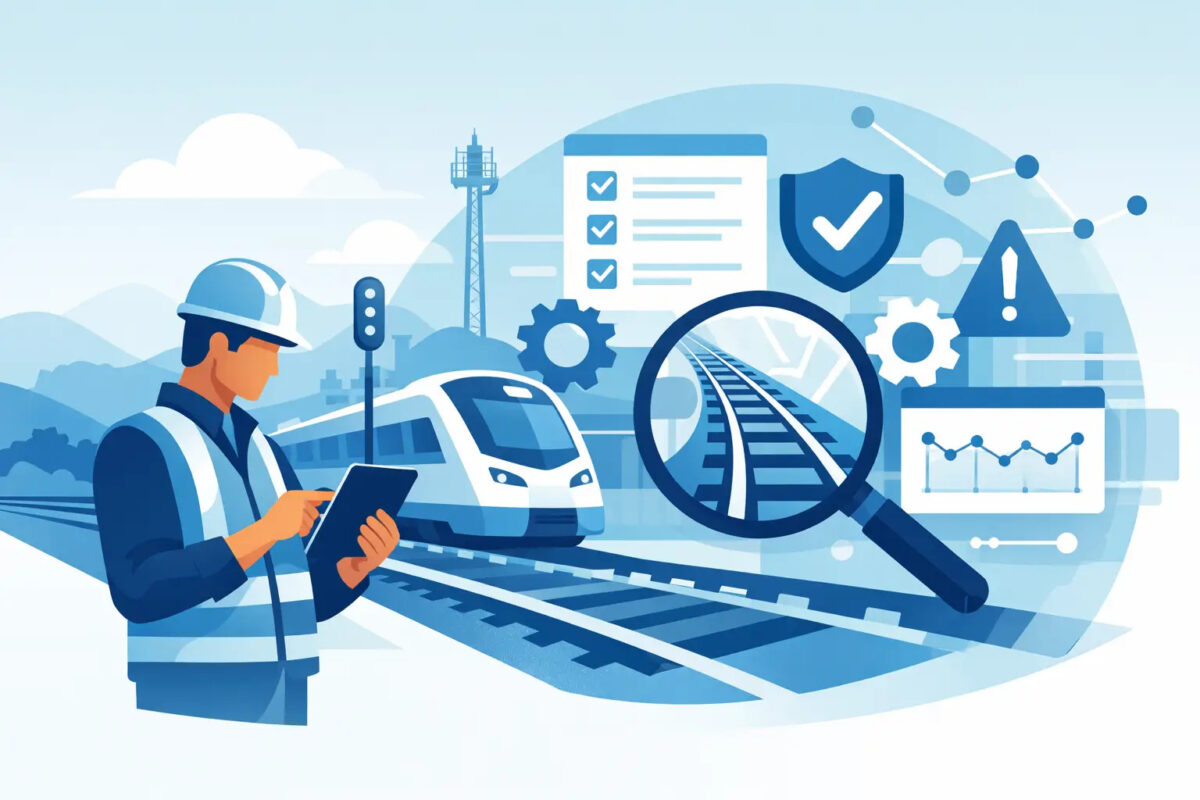

A late-reported defect, an inspection form left in a cab, or a corrective action that disappears into an inbox can all create the same problem: leaders believe a control is in place, but cannot prove it is working. Rail safety assurance software gives station teams, mobile workers, contractors and managers one practical way to capture issues, assign action and maintain a defensible record while work is happening.
For rail organisations, assurance is not a document produced for an audit. It is the day-to-day evidence that hazards are identified, checks are completed, actions are owned and recurring problems are addressed. The challenge is doing that consistently across stations, depots, offices, compounds, vehicles and infrastructure – without adding paperwork that frontline people will understandably avoid.
Why rail assurance often breaks down
Rail operations involve dispersed sites, changing shifts and a mix of employed staff and contractors. Information can start on a paper form, move into a spreadsheet, be discussed in a local meeting and eventually be entered into a central system. By then, the detail may be incomplete and the opportunity to deal with a risk early may have passed.
The issue is rarely that teams do not care about safety. More often, the reporting route is too slow, too complicated or unavailable when it is needed. A member of staff may spot damaged tactile paving, poor lighting, a platform-trip risk or an unsecured access point, but defer reporting it until the end of the shift. Small delays create gaps in the record and make it harder for local managers to see what needs attention now.
There is also a difference between recording activity and providing assurance. A completed inspection alone does not show whether a failed item was corrected, who accepted the risk in the meantime, or whether the same issue has appeared elsewhere. Assurance requires a connected chain from observation to action, verification and management oversight.
What rail safety assurance software should achieve
Effective rail safety assurance software should make the safe process the easiest process. A user should be able to log a hazard, near miss, fault, inspection finding or incident on a mobile phone or tablet, attach photographs and location details, and send it to the right person without needing to understand the system behind it.
That simple starting point matters. If reporting takes minutes rather than forms, emails and follow-up calls, organisations get a fuller picture of their operational risk. Managers can spot issues early before they escalate, while assurance teams receive structured information rather than trying to reconstruct events from fragmented records.
The system must then turn reports into controlled activity. This means assigning corrective actions, setting due dates, escalating overdue tasks and recording evidence that work has been completed. It should also preserve the audit trail: what was reported, when it was reviewed, who made each decision and what evidence supports closure.
For a rail operator or infrastructure manager, the practical capabilities usually include:
- mobile reporting for hazards, faults, near misses and operational concerns;
- configurable inspections, audits and checklists for different locations and work types;
- corrective-action workflows with ownership, reminders and escalation;
- dashboards that show trends, outstanding risk and performance by site, region or contractor;
- offline working for teams operating where connectivity is unreliable; and
- secure records that support internal review, client reporting and regulatory scrutiny.
The exact configuration depends on the organisation. A station operation may need focused daily checks for passenger areas, accessibility features and public safety. A maintenance contractor may place greater emphasis on worksite inspections, plant defects, permits and evidence of completed remedial work. A good platform accommodates both without forcing every team into the same unsuitable form.
Mobile reporting is a control, not a convenience
The value of mobile-first reporting is often underestimated. A report made at the point of observation is more accurate than one recalled later. Photos can show the condition as found, while standard fields can capture the site, asset, severity and immediate action taken. That creates a record that is useful to the person resolving the issue as well as to the person reviewing assurance performance.
Offline capability is equally significant in rail settings. Teams work in locations where signal is inconsistent, from back-of-house areas and depots to trackside environments. If an application only works with a stable connection, people return to notes, paper or memory. The right tool allows staff to complete the report when they find the issue and synchronises it once connectivity returns.
This does not mean every report should become lengthy. The best designs use clear categories, sensible defaults and simple language, with additional detail requested only where it helps a decision. For example, a broken handrail needs a precise location, image and immediate safety controls. A routine housekeeping observation may need much less. Making every form equally detailed can reduce adoption and obscure the issues that deserve urgent attention.
Turning corrective actions into visible control
An open action is not necessarily a failure. Some repairs need parts, access arrangements, possessions or third-party approval. The real risk comes when nobody can see that the action remains open, who owns it or what interim controls are protecting people.
A well-configured assurance system gives each action a named owner, target date and status. Managers can see overdue items and challenge delays before they become normalised. Where an issue cannot be resolved immediately, the system should record the reason, the temporary control and the planned next step. That is far more defensible than a vague note saying that the matter has been passed on.
Closure also needs discipline. It may be appropriate for the person who carried out a repair to mark work complete, but higher-risk actions may require independent verification by a supervisor, manager or assurance lead. The workflow should reflect the level of risk rather than apply the same approval process to everything. Too much sign-off slows routine work; too little leaves doubt about whether controls are effective.
From local reports to network-wide learning
A single report may look minor. Fifty similar reports across a region are a pattern. This is where reporting and assurance data become valuable to operational leaders.
Dashboards should help teams ask useful questions: Which stations have repeated slip, trip and fall observations? Are inspection completion rates declining on particular shifts? Which contractors have a growing volume of overdue actions? Are the same asset defects appearing across multiple sites? These are management questions, not just reporting questions.
Trend information should be used carefully. Higher reporting numbers can indicate increased risk, but they can also indicate improved reporting culture. A site that suddenly reports more near misses may be giving management better visibility, not performing less safely. The context comes from looking at severity, recurrence, action completion and local operational change together.
This is why configurable reporting matters. Rail organisations need consistent core data to compare performance, but they also need forms and workflows that fit their actual processes. A-N-T supports this balance through practical mobile tools that can be configured around existing assurance activity, avoiding the expense and disruption of a fully bespoke system.
Building adoption across frontline teams
The strongest assurance process fails if people do not use it. Frontline adoption is not achieved through a launch email or a lengthy training session. It comes from making the system quicker than the workaround, giving people feedback when they report something and showing that reported issues lead to visible action.
Local managers have an important role here. When they review reports promptly, assign actions clearly and close the loop with staff, reporting becomes part of normal operational control. When reports vanish without response, people stop seeing the value in raising them.
It is sensible to begin with the processes that cause the greatest administrative burden or legal exposure, such as hazard reporting, inspections and corrective actions. Once teams are using those consistently, further modules can be introduced for audits, incident management, lost property or other operational workflows. Phased implementation is often more effective than attempting to digitise every process at once.
Choosing a system that stands up to scrutiny
When assessing rail safety assurance software, buyers should look beyond a feature list. Ask whether users can report from the field with minimal effort, whether workflows match real approval routes, and whether the system records decisions in a way that can be retrieved months or years later.
Support matters too. Configurable software still needs a provider that understands the operational consequences of a poorly designed form, a confusing status or an impractical reporting route. Direct, responsive support helps organisations refine the system as requirements, contracts and risk profiles change.
The most useful assurance platform does not create another layer of administration. It gives frontline teams a simple way to raise what they see, gives managers a clear view of what needs attention, and gives the organisation credible evidence that safety controls are active. That is how routine reporting becomes a stronger, more accountable rail operation.